Whether you’re ready to hire your first employee or your hundredth, finding the right person for the job can feel impossible. In the best of times, you have an abundance of candidates to filter through and the stress to find the best fit can be overwhelming. In lean hiring months, you may feel like you are making compromises and hoping that the time and effort you invest into the available candidate pays off.
But it doesn’t have to be this way. In his article “The Critical Role Job Descriptions Play in Organizational Success,” HR expert Joshua Kiernan synthesizes research on some of the main issues that lead to poor hiring and retention issues. In this article, I will focus on three of these issues and share simple strategies that you can implement to strengthen your hiring practices.
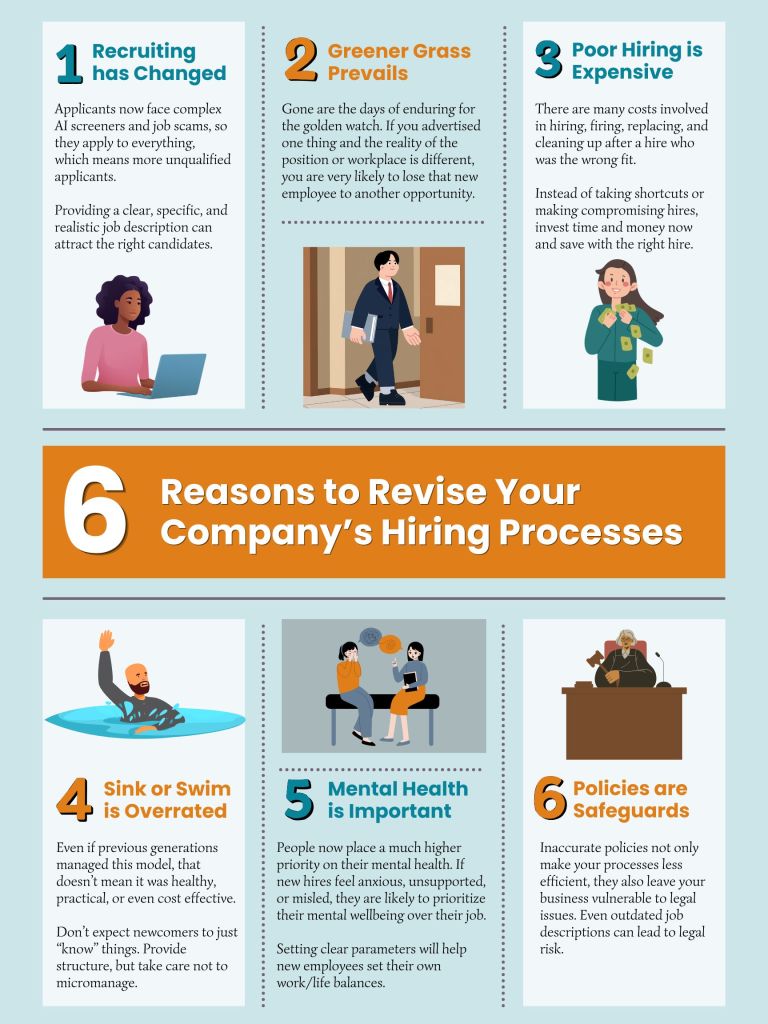
Problem 1: Inaccurate Job Descriptions
Poorly written job descriptions are so common that employees often respond tongue-in-cheek that a task “wasn’t in their job description” when asked to do something new. But Melissa Duncan with JDX cautions that poorly written job descriptions can be used against your business in legal disputes and that you should avoid relying on “broad ‘other duties as assigned’ language to maintain flexibility” and that you should, instead, update documentation for clarity.
Solution
The simple answer is to update your job descriptions, but that process can be more complicated than it sounds. “Updating” isn’t the same as making an accurate job description. And even how you define “accurate” will vary depending on who you ask. So, before you add this task to your HR Manager’s job description, start by answering the following question:
Do I want to know what this employee does already OR do I want to redefine the parameters of this position?
Your answer to this question will say a lot about where you need to go for information (and may shed some light on your leadership style, but that’s an entirely different article). If possible, it’s always best to start with the Subject Matter Expert (SME) – in this case, the employee. Even if you are seeking to redefine a position, involving the affected employee(s) will generally increase buy-in versus having new tasks assigned to them without warning or input.
According to Allegis Group, while 72% of hiring managers believed they provided clear and accurate job descriptions, only 36% of candidates agreed. This level of misalignment is not helping businesses or candidates.
If you are creating a new position, ask the people who will be directly involved with that new employee some key question, like: What do they expect from this person? What will they need? What qualities are important to them in a new coworker?
If your company culture isn’t in a place where you feel you will get transparency about workplace responsibilities, then you may want to bring in an outside consultant like Root Cause Consulting to gather information. The up-front investment can help prevent the stress and cost of employee turnover and the frustration of having to revise inaccurate documents.
Problem 2: The Onboarding Process is Not User-Centered
Most people can recall the excitement of a new job being dampened by the reality of sitting alone in a fluorescent lit office filling out stacks of paperwork and watching hours of poorly acted orientation videos on their first day – or maybe even week. Yes, there are important papers and policies that need to be reviewed by all employees, but remember that your onboarding process is your new employee’s first real introduction to the business. According to Indeed, that good first impression from the interview “is fragile and much can go wrong from day one if your company doesn’t invest in making [the new employee] feel welcome, engaged and prepared for what their job will entail.”
The good news is that, according to Durga Prasad Uppu on LinkedIn, “companies with effective onboarding retain 91% of their first-year employees compared to those with inadequate onboarding.” So the question becomes, how do you make your onboarding process effective?
Solution
Here is the not-so-good news: there is no quick fix, one-and-done solution. If there was, everyone would be doing it, and effective onboarding wouldn’t be a topic of discussion. There are many, many digital resources to support your choice, which range from document templates to complex LMSs.
But before you stop reading in frustration, hear me out.
Creating a successful onboarding process is not about the perfect solution. It’s about finding a balanced solution for your users. Getting there requires answering some questions.
Who are your users?
First and foremost, your users are your employees; but also, your business as an entity. Businesses often buy the complex software and try to make their business fit the templates. Or they look at what everyone else has done and assume that they need to do the same. Yes, models are helpful. Yes, obey laws and be aware of what your HR department needs to do. However, also keep your users’ needs front and center.
What MUST I include?
Start with the basics. Refer to your state’s laws and regulations to ensure you know what forms, policies, and information must be covered in your training. There is usually flexibility in how information like sexual harassment and disability awareness trainings are presented, but their inclusions are mandatory, so get them on your list.
Check to see what is required for your sized business. Requirements change as you add employees. If you are growing your team, your policies might need to be updated, too.
Don’t worry about making these materials yet. Make a list, gather forms, do your research to know what needs to be included. You are in the information gathering stage.
This is where many businesses stop in their onboarding development. Don’t leave your new employees with the bare minimum. Your business is robust and important. Show them it’s depth and their role in developing it!
What do my users need or want?
Now you’re getting to the good stuff! There are some elements that research has shown create effective onboarding when implemented successfully:
Pre-boarding Communication: emails, early information access, and work buddies can all help alleviate first day stress, explains Prasad Uppa.
Clear Communication: research across the board supports that new hires (and established employees) want clear and frequent communication. Do not misread this request as micromanagement. It is a desire for connection into the established social and procedural systems of your business. Consider how best to help your new team member connect.
Provide Clear and Attainable Goals: especially at the beginning, it’s best to provide realistic and achievable outcomes for your new employee. Avoid the old “sink or swim” mentality where they will figure things out on their own. Provide a task and the resources for them to accomplish it, set a deadline, and then debrief.
Training: yes, your onboarding process should include job-specific training. No, that does not mean that HR should be in charge of all training. If your business is large enough, that may mean that you have a separate team or department for training. If it’s not, you may need to bring in a consultant like Root Cause Consulting to help you develop materials you can use as you expand. (See more about the importance of training under Problem 3: Unclear Follow-Up.)
Beyond these elements, the best thing to do is ask your users! If you are a small team, you can imagine yourself as a new employee. However, it is hard for owners, managers, or more established employees to effectively imagine what someone new might need or want. Plus, you risk applying your own biases to the process. It’s best to ask current, past, or potential (or even hypothetical) employees whenever possible.
How do my users prefer to get that information?
This is another often overlooked question and it requires you to talk to your users. Do not assume that they want a 3-hour animated video that you invest thousands of dollars in when they would have been just as happy with a mixture of open-source resources mixed with original recordings directly from you.
Be open to what your users suggest and take that feedback into consideration as you balance the needs of your business entity with your employees.
Problem 3: Unclear Follow-Up
The final problem occurs when business owners and leaders believe that a well-qualified employee will flourish after a brief orientation and some training. And while many experienced professionals will attest to surviving in this “sink or swim” environment in their pasts, most will not recommend it. Just like freshmen college students aren’t expected to produce doctoral-level work, you should not expect even a smart, well-qualified, and experienced new hire to know everything there is to know about your business.
Yes, trust their expertise, but give them scaffolded opportunities to learn who you are as a business, what you want from them specifically, and how they can meet those needs. If you throw them in the water and they start swimming the backstroke, but you get upset because you wanted them to do the butterfly, you will have one very frustrated new (and possibly ex) employee.
Solutions
Milestone Check-Ins
Depending on what is right for your new employee and business, schedule check-ins from the start that correspond with projects or learning milestones. Scaffold these milestones so that the learning and responsibility builds appropriately for the position. These check-ins should be low-stakes and low-stress meetings with some mentorship, but there should be clear expectations.
Here are some questions you can adapt for your particular situation:
- This week/month you were working on X. What aspect of that project do you feel you mastered? What related skills/strategies are you still working to improve?
- [Insert value] is really important to us here. Now that you’ve been here a while, how do you understand it? How have you seen other people enact it? Have you had a chance to put that value into action yet? If so, how? If not, can you think of any missed opportunities?
- Finding the right people here can be hard. Is there anyone or any resource you have been trying to find that I can help you to locate?
- So far, which of your previous skills do you feel you have used the most here? Would you share an example?
- Is there a specific skill of yours that you feel like you haven’t gotten to use yet? Have you seen an opportunity or would you like to talk about how that skill might benefit you in this position?
- Is there any kind of training that would help you to do your job better?
- Let’s discuss your next milestone. These are the goals I have for you. These are my concerns (if any). Do you have any questions or need any resources to move forward?
Training Opportunities
Learning does not occur all at once, so don’t assume that a few days of training during onboarding will address all of your employee’s learning needs. If you want your product or service to be consistent, if you want to reduce wasted time and resources, you must provide initial training AND refresh those practices over time. Do not expect a new hire to learn on the fly and do something that you have perfected over months, years, or decades. And don’t let that acclimation process tarnish your business’s hard-earned reputation.
How, when, and how frequently you train will vary depending on your business and your new employees’ needs. However, making it clear in your hiring process that you support continuous learning sends a powerful statement to your employees that you value their knowledge and growth.
Here are a few options to support your employees’ training needs:
Peer Mentoring: let a more experienced staff member guide the new hire, but it’s best to provide some structure. For example, you could have them review SOPs or particular tasks and then “test” with another employee or higher up. Or you could create a worksheet for them to complete together for the desired training area.
Structured Training: if you have several people who need refreshers on the same tasks, dedicate a few hours or even a specific day for structured training. Have a Subject Matter Expert (SME) guide them through the activities.
Prepared Training: positions that require multiple employees may benefit from prepared recorded training. A consultant like Root Cause Consulting can customize interactive training materials that meet the needs of your business and future employees.
Online Training: depending on the skills needed, you or your employee may find that the best trainings already exist online. If they want to get better with a particular software or media skill, for instance, there are many paid and free resources online. Tip: any Fresno County Library cardholder has free access to LinkedIn Learning, which has hundreds of free trainings and valuable resources.
Finding the right employee can feel overwhelming, but don’t let the pressure push you to make compromises that will cost your business time, money, and possibly even clients. If you would like help implementing any of these steps, please contact Sheri McClure, Ph.D. from Root Cause Consulting at SheriLMcClure@gmail.com or 559.930.1735 to set up a consultation.

